Wednesday, December 5, 2012

In the Tubing Vang Vieng

When I look back on it, my next two stops in Vang Vieng and Luang Prubang are some of the places I remember most fondly (discounting the bus rides between these places!).  As touristy/backpacker-y as it was, Vang Vieng was truly beautiful.  On the main street, all of the establishments looked very similar.  The places to eat, like most places in Southeast Asia, were open to the streets.  Cushions and low tables were set up on platforms.  This was more like a place to sit and hang out, or even curl up on a comfy pillow, than a place to sit and eat a meal.  And at each restaurant, numerous TV screens repeatedly played reruns of Friends and Family Guy.  That was the part we could have easily done without, but somewhat in our favor, the power went out in Vang Vieng for at least a portion of every day.  (This was fine when we were eating, of course, to avoid the TV shows, but bothersome when we were trying to sleep in our hot room at night and the fan stopped working or in the morning when we wanted to get fruit shakes but none of the blenders worked.)  Various shops sold sunglasses, “In The Tubing Vang Vieng” tank-tops and T-shirts, and beautiful silver jewelry.


Away from the main street was where Vang Vieng stole my heart, however.  After relaxing in town for the first part of our first day, we rented tubes and took a tuk-tuk down to the Nam Song River, which flowed between the tall limestone karsts and just west of the town.  I had heard from a friend about tubing down the river in Vang Vieng: how it was lined with bars, and every year tourists ended up getting wasted and lost out on the river past dark, then drowning.  Because it was the dry season, the river did not pose as great of a threat, and we didn’t have plans to get so drunk that we wouldn’t get back in time to receive back the deposit we had made on our tubes.  When the tuk-tuk dropped us off, we walked about 500 meters down a dirt path beside the river before finding a place to enter the river.  The water was cool but comfortable.  I clipped my shoes and clothes to my tube and we set off down the lazy river.


Bungalow-style bars made of bamboo lined the river.  Each had something to draw tubers in: large porches, rope wings, water slides, zip lines, loud music, trampolines, and of course, alcohol.  Staff members waded into the water, trying to drag people in by their tubes or throwing ropes out to pull people in.  Malone and I avoided these attempts and continued floating along down the river.  The tree-covered limestone mountains were beautiful where they rose high above us against the sky.  The water itself was clear and strangely devoid of fish or much else, other than the floating leaves, occasional stick, and thankfully even more seldom plastic water bottles.  Though the water was shallow, we floated easily along, only occasionally needing to navigate between groups of rocks.


At one point, we rounded a bend in the river, and it was perhaps at this point that the place’s beauty struck me the most.  The mountains were greener, the water looked almost green, perhaps because of this tropical reflection, and the bars had thinned out so the place was more secluded and wild.  It was quiet here and peaceful to float down the river, looking up at the endlessly impressive mountains.  As the sun began to lower behind the mountains and the water began to feel a bit cooler, we exited the river and got a tuk-tuk back into town.  Still in our wet clothes, we stopped on our walk back to our hotel for some warm noodle soup.  From our porch, we watched the sky come alive as the sun set behind the mountains, then went back into town to shop and enjoy an evening snack: fruit shakes and street pancakes.  If I could only live many more days like that first day in Vang Vieng!


Saturday, April 28, 2012

Ugh

Our next stop was Phitsanulok, which sounded much better in the guide book than it actually was.  When we arrived after the hour-long bus ride, we checked into the “Guest House Hotell” and set out in the blistering heat to look for a bookstore that we never found; have lunch at a Vietnamese restaurant, where I accidentally ate some kind of dried, shaved pork (weird); walk around some more in search of the Buddha casting factory, which we never found, and the bird park, which we also never found.  Phitsanulok didn’t do a very good job with their tourism industry; we couldn’t find a map anywhere!  We did go to Wat Phra Si Ratana, a famous temple, but I think we’d had our fill of wats by that point.  After dinner, we walked by all the street vendors selling food beneath a full moon, which was very bright for a city sky.


The following day was actually even worse.  We took a tuk tuk to the bus station; the tuk tuk was a carriage hooked on to a bike.  Not a motorbike—just a bike.  There was barely enough room for the two of us in the carriage, and our backpacks hung precariously from an S-hook on the back of the carriage.  We had breakfast at the bus station and got on a late morning bus to Udan Thani.  This is my number one recommendation to anyone traveling to Udan Thani: get there early so you can catch the next bus.  We failed to do this.  We therefore had to spend the night in Udan Thani.

Why wouldn’t you want to spend the night in Udan Thani, you ask?  Though the town is a transportation hub, with three major bus stations, it is also the capital of sex tourism.  Therefore, everywhere you look, there are fat, old, white men—the ones who wear white socks with sandals and have giant beer bellies—walking around with beautiful young Thai women.  It was utterly depressing.  Every place in that town was shady.  We even had trouble finding places to eat.  We also had trouble finding a place to stay.  A young man took us around the city in his tuk tuk, which was motorbike driven, to hotel after hotel, looking for a place we could stay, his brakes squealing like a dying animal the whole time.  Finally, we found a place that had room.  It was expensive for what it was.  It was the first place we stayed that had a squat toilet; the sink didn’t have a drain, so when you ran water, it just ran straight to the floor and drained from there; there was a cockroach in the bathroom; and the sheets on the beds had clearly never been changed.  Not wanting to spend any time in that room, we left for dinner and then walked around a night market, which was more like a mall.  It was an equally depressing place because tons of puppies were locked away in small cages, waiting to be sold.  When it was time to sleep, we walked back to our room.  Malone and I shared what looked like the cleaner bed and we spent what was probably the worst night of the trip.

Our third miserable day started early in the morning when we got on a bus to Vientiane, Laos.  On our way to the border, the bus stopped along the side of the road; somebody took our backpacks out of the storage area of the bus, and a man pointed at us through the window and told us to get off.  Confused, we got off, and a tuk tuk driver took us to a building where we could get our Laos visas.  The problem with this was that we were pretty sure we could get our visas at the border, just as we had when we arrived in Thailand.  However, we had been kicked off the bus, didn’t know where we were in relation to the border, and didn’t really know how to ask.  We sat there, aware that we were being ripped off, and handed over our passports to the woman behind the desk, who filled our a few forms for us and charged us between seventy and eighty dollars for the process.  Two women then got into the tuk tuk with us, which took us to the border, and we felt our stomachs sink when they marched us up to the “Visa Upon Arrival” sign and handed us $36 each—the cost of the Laos visa.  That’s right—we paid almost $80 for a $36 visa and a $1 bus ride across the Friendship Bridge between Thailand and Laos.  We were angry, so angry—but there was nothing we could do at that point.  The Lao official at the counter lightened the mood a little by making fun of us for what had happened.  I bet he sees it all the time.  We learned our lesson, though, and wouldn’t be fooled again, though the Thai people would try to do the same at the Cambodian border and at the Malaysian border—and get this—the Malaysian visa is free!

From the bus station in Vientiane, the capital of Laos, we found ourselves in another sketchy situation.  We tried to arrange a mini-bus ride to Vang Vieng, and we followed around a couple of men who kept arguing with each other and handing each other money, until finally one of them took us to his mini-van.  Somewhat terrified, wondering where we would be taken, we finally relaxed (though Malone got super car sick) and eventually arrived in Vang Vieng, where we were taken to a somewhat pricey bungalow that afforded a beautiful sunset view.  The peacefulness of the Nam Song River and the beauty of the sunset between the limestone karst mountains relaxed us and prepared us to enjoy a beautiful place in the coming days.


Friday, April 27, 2012

Ancient Ruins and Noodle Soup

The following day in Sukhothai was one of the best days of the trip. It was also one of the hottest. After a breakfast of pineapple pancakes and fruit salad, I walked to the post office to mail Sam’s birthday present to Vermont and a post-surgery feel-good letter to Scott. Even though it was still early—before eleven—the sun was beating down on me and I could not stop sweating. On the way to the post office, I passed a parade of sorts, with Chinese dragons, people in costume, a marching band, and a small float that looked very tacky compared to the floats at the Flower Festival in Chiang Mai.

After I walked the hot sidewalk back to the hostel, Malone and I gathered our things and walked down the block to catch a bus to the Sukhothai Historical Park. The bus was more like a giant pick-up truck, with two bleacher-like wooden benches lining the two sides and one running down the middle. The vehicle was open, to let the hot air blow through.

At the park, we rented bicycles for 30 baht each (about one US dollar). Somehow, but unintentionally, we entered the park without paying and began to bike around. We first reached the largest ruin: Wat Mahathat. We took our first pictures of the ancient stupas of crumbling brick and the giant Buddha statues that sat so nobly and serenely in front of them. We could see Wat Sa Si and Wat Tra Phang Ngoen across the water, in the distance. The latter looked particularly beautiful, with a pure white Buddha sitting regally in front of a muted mountainscape.


We left the main part of the park on our bikes to go to Wat Si Chum. We rode past trees with bright orange blossoms that fell to the ground and spread there like a monk’s robes; brilliant green rice paddies; a mote-like creek that encircled part of the park; barking dogs; dried grasses in the heat; views of mountains. We paid 110 baht to go into this part of the park and stopped at an elaborately carved ebony stupa near ruins that must have been consumed by fire at one point: Wat Phra Phai Luang. At the entrance to Wat Si Chum, Thai school children were excited to practice their English on us, each one of them yelling “Hello!” with big smiles on their faces, then running away to giggle with each other. I bought a bottle of ice cold water before heading inside Wat Si Chum, where the biggest Buddha we’d seen sat with one gold hand cupping its right knee, staring fixedly out into space. It was nearly impossible to capture the whole statue in my camera lens.


After paying a second entrance fee of 110 baht at the third part of the park, we rode our bikes to Wat Saphan Hin, which sat high on a hill overlooking fields and the other ruins of the park. We climbed a path made of stone to the top, where one Buddha stood with its hand raised to the light and a smaller Buddha sat before it, both gazing out at the view. We lit incense and gazed outward with the Buddhas.


After climbing back down, we continued riding our bikes around the park, finding ourselves in an odd situation where we bought a Coke out of an old woman’s bedroom, and then riding past more ruins, the wats all reduced to crumbled brick walls and stupas. When we reached the road that surrounds the main part of the park, we stopped for the best lunch that we had the entire trip, and it wasn’t just because we were so hot, hungry, and tired from biking. Malone ordered pad Thai; I had an ice cold mango shake and a vegetable and noodle soup.  I still crave the combination of crushed peanuts, cilantro, and scallions when I think about that bowl of soup. We ate in the shade while a puppy nibbled at our toes.

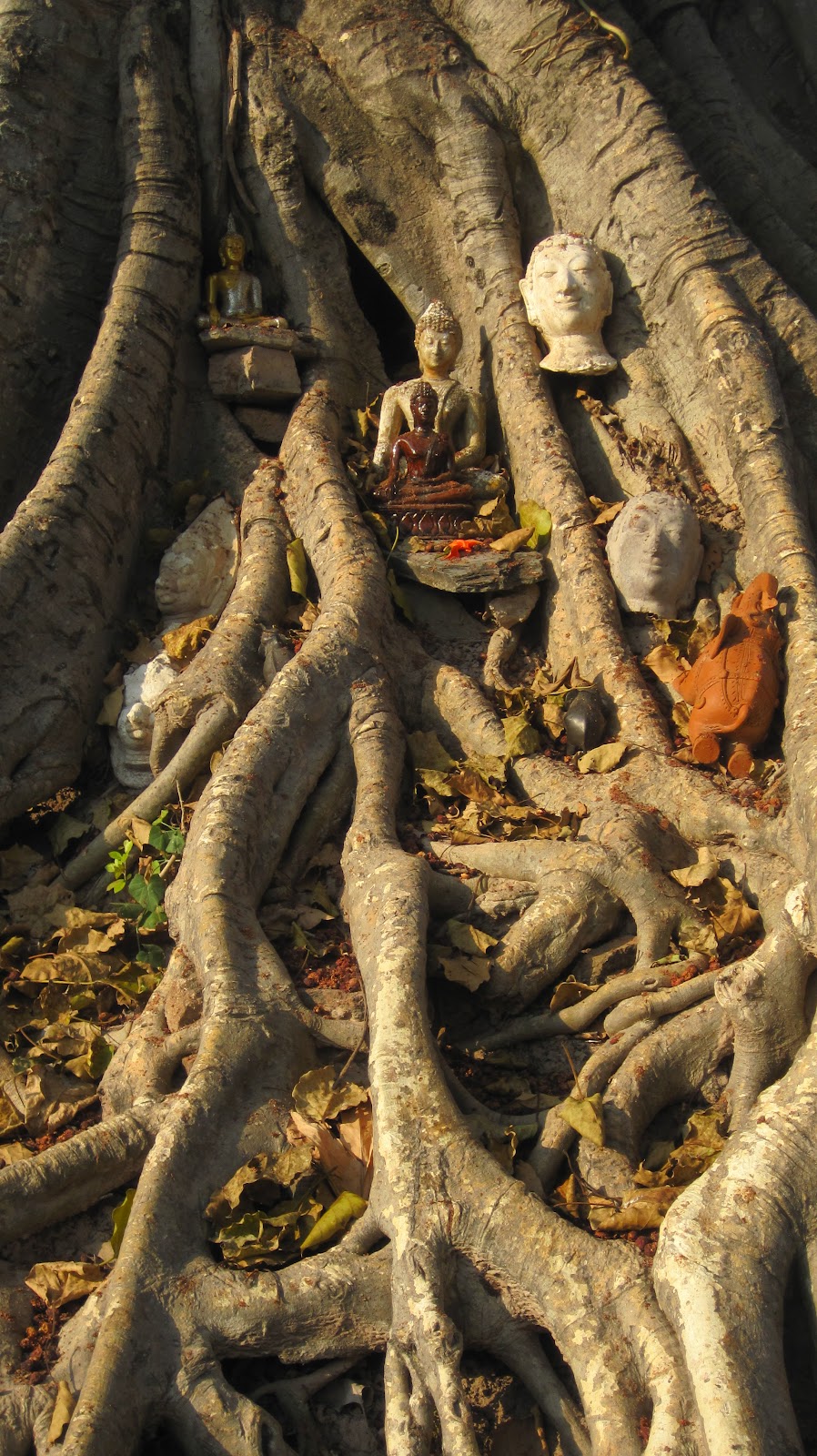
We rode our bikes back to the main part of the park, this time paying the 110 baht entrance fee, and headed along a path shaded by trees in the late afternoon light. We visited Wat Si Sawai, where small Buddhas were tucked into the roots of a tree and a flock of pigeons swooped over the tallest stupa and perched there. We relaxed in the shade along an old brick wall, next to the creek where a small turtle came up to breathe and a heron perched in a tree that shone with golden green afternoon light.


All in all, it was a perfect day. We returned our bikes and took the bus back to our hostel, where we showered and relaxed for the night and enjoyed a small dinner at a coffee shop a few buildings down. The beauty of the day in Sukhothai would carry us through the next three somewhat-miserable days.

Thursday, April 12, 2012

Tears in Pai

The next day in Pai was an emotional one for me. It was one of my lower points on the trip. I was homesick for Scott and disappointed to find out that I wouldn’t be working with sea turtles again that summer. Calling my mom on her birthday just made me more homesick. When we took the motorbike outside of Pai that morning on our way to Huay Nam Dong National Park, the scariest part of the whole trip happened (at least it was the scariest part for me). We were driving up winding hills that curved back and forth as we gained elevation. I think both Malone and I knew it would happen, but there was nothing we could do about it. Up ahead, the bend was completely covered with pine needles. We skidded out on the needles and the motorbike fell onto its side, spilling us into the street. I sort of had to jump away from the bike so it wouldn’t crush me or so we wouldn’t crush each other. It hurt. We were so lucky that a truck or car had not been following us. I don’t even want to imagine what would have happened. As it was, Malone had a terribly bruised knee, and my knee and ankle were cut open and half of my big toenail had been scraped off by the pavement. We picked the bike up and kept going to the park, but as soon as we got there, I lost it. I cried because I was scared to get back on the motorbike to drive back, because I was homesick, and because my knee hurt. I guess I was just overwhelmed and needed to let it out. Unfortunately, my tears put a damper on the morning, and it was hard to enjoy the view of the park, though it was absolutely beautiful and the day was sunny and filled with color.


We hung around at the park for only a little while before we returned to Pai. I think we were both a little hesitant to explore the park on the bike, since many of the roads were unpaved and bumpy. And our legs hurt from the fall, so it wasn’t really worth finding any trails to walk on, either. So we went back to Pai, and I tried to relax with a hot shower and some downtime.

Another reason that my emotions were high was that Scott was worried about me. It made me anxious; I knew that if he was worried about me, it was possible that something could actually happen to me. I felt very vulnerable and very subject to injury, especially after the motorbike fall. At the night market in Pai a day or two before, I had seen a woman in a wheelchair being pushed around by a man who was singing into a microphone. They were collecting money. The woman had no legs. She had no arms either. One of her arms was missing after the elbow, but the other was missing even higher up than that. We would see many limbless people in northern Thailand, Laos, and Cambodia: results of the unexploded ordinances left by US soldiers during the Vietnam War. The US soldiers crossed into Laos and Cambodia without permission from those countries, and the landmines are still injuring and killing people today. It is the most heart-wrenching memory of my trip: that these innocent people—farmers, children, just people out walking in the woods—have lost their limbs and sometimes their livelihoods. I read somewhere about a flower that scientists had genetically engineered to detect landmines. The flowers are white, but when they detect the chemicals present in the landmines, they turn red. I imagine parents teaching their children to never go near those red flowers. It makes me want to cry.

I spent Valentine’s Day in Pai, and I don’t remember what we did. My journal just says “Another day in Pai,” and the rest of the text is just reflection. Perhaps it was a day of relaxation: reading, writing, enjoying food, the night market, the sunset, etc. Scott left a video on my Facebook wall of him singing “Half Moon” by Iron and Wine, and that song still brings back memories of being in northern Thailand without him and missing him like crazy. But on the 15th, Malone and I spent our last morning in Pai. It was time to move on. We had our last breakfast in Pai, bummed around near the bus station for a while, then took a mini-bus back to Chiang Mai.

Our stay in Chiang Mai was quick. We went back to the Little Bird Guest House, had some dinner, then went to the night market. I had left my sunglasses in the mini-bus, so I bought a pair at the market, as well as some gifts: silk change purses, a wooden bookmark with a metal engraving, a flower carved out of soap, a ceramic pipe, an alligator carved out of jade, an ink drawing of an elephant. The following morning, we packed our things again, had breakfast, and took a 5-hour bus ride south to Sukhothai, the ancient Thai capital. Our beds at the Garden House were as hard as the floor, and the air was hot and filled with mosquitoes. But we were moving forward with our travels after our long stay in Pai.

Sunday, February 19, 2012

Waterfalls

We went back to Pai because we liked it, but I guess we also went back because we didn’t really have a plan. The WWOOFing that we had hoped to do—volunteering on organic farms—wasn’t working out. Every place we contacted had no space for us. This was the point of our trip where I realized that we were basically on a long vacation.

The bus from Soppong back to Pai was crowded. Malone was lucky enough to get a seat… lucky, that is, until the seat in front of her collapsed into her lap, and she spent the rest of the ride holding it up with her knees. I was stuck standing in the aisle the whole time, with a tiny Thai girl in her parents’ laps to my left, and two novice monks, about ten years old, standing in front of me. The smaller of the two monks was leaning his head on the other’s shoulder. It looked as if he were sleeping, though he was standing up. When the two got off the bus, I saw one of the monks take out his cell phone and make a call. It was such a startling image: a ten-year-old boy—bedecked in orange robes, hair shaved close to his head—talking on a cell phone in northern Thailand.


We settled back in at the Darling View Guest House. This time, we got our own private room, which was actually cheaper than renting beds in the dorm room. Our room had its own porch, overlooking the valley, with a hammock and benches and lots of pink flowers. We stayed in Pai for five nights, simply because we were content there. It was quiet, peaceful, and beautiful, and it was a safe place to explore on our own.


On our second day, we rented a motorbike and drove along some dirt roads past farmland, small bungalows, stray dogs, and banana trees. We parked at the trailhead that led to Mae Sen Waterfall. What we thought would be a short stroll to the falls turned out to be an all day hike—too bad we hadn’t packed food and only had half a bottle of water between us! It took us about two and a half hours to get to the falls, and two and a half hours to get back. I confess that Malone could have completed the hike much more quickly, but then again, her legs are twice as long as mine. My difficulties hiking were compounded by the fact that sand from the riverbanks was getting stuck beneath the straps of my sandals, rubbing my skin raw and giving me blisters. Despite these complaints, the hike was beautiful, with banana trees, pale purple flowers, and vines that twisted between the trees. We had to cross the cold creek several times—back and forth, back and forth—to stay on the trail, which could not remain on one side of the water because of the rock faces that emerged. We scrambled over some boulders as we got closer to the falls. When we arrived, the falls greeted us in three long curves of white water sliding down the rock face. Water collected in a small pool at the base, and pale blue butterflies clustered above the sandy beach. Walking back to the motorbike, the afternoon sunlight was golden through the forest, and the cold water was soothing on my hot feet. Cold water, fresh-squeezed orange juice, and a dish of pad Thai never tasted so good as when we returned from our hike!


The next morning, we took the motorbike to the Pai Hot Springs. It was cool on the bike in the morning, especially in the shade, but the scenery was wonderful: a patch of dry, autumn-like forest, with dry leaves on the ground and leaves browning in the trees; one tree with orange blossoms, the color of monks’ robes; a cattle pasture and small farms; two straw huts in a field; a tall, straight eucalyptus tree on the side of the road; small plantations of tall, skinny trees with sparse, dry leaves the size of dinner plates; stray dogs; old women walking; lots of green; views of the mountains; sunshine and shade. We saw our first elephants at Pai’s elephant camp; some were walking along the road, and we had to move into the opposite lane to pass them!

We weren’t prepared to go inside the hot springs—I guess we didn’t really know it was allowed—so we just dipped our feet in for a while. The park itself was very quaint, with stone walls and a walking path. We walked past some of the hotter springs that sent steam into the cool morning air. The hottest spring had a sign—“No boil egg”—which was even funnier than seeing the bag of eggs boiling in the one before it.


After the hot springs, we drove to Pam Bok Waterfall, which wasn’t as impressive as the falls we saw the day before. The good thing about this waterfall, though, was that we didn’t have to hike the entire day to get there—it was only a 150 meter walk. The falls were a bit dry, but the short walk was nice. The path squeezed between boulders and cliffs, and smaller pools of water created short water falls. A rickety bridge crossed the stream of water. The drive back to Pai showed us more of the beautiful countryside: mountain, valley, and farmland. After returning the motor bike, we put on some sunscreen and went down to the Pai Riverside to have a drink and read and relax. I dipped my feet in the water while Malone borrowed somebody’s tube to float down the river. Though the afternoon sun was hot, we had to be sure to shower before the sun went down, because the evenings and nights in Pai were quite crisp!


Watching the sunset that evening in Pai, I wrote in my journal: “I could have this view forever.”

Thursday, February 16, 2012

Butterflies in Thailand

When we woke up in the morning, it was cold out, and mist shrouded the mountains. We sat by a small fire, where water for lemongrass tea was boiling in a large black kettle. We ate chunks of pineapple, papaya, mango, and watermelon, then rice with milk and honey. Albert ate with us, though Susanan didn’t.


Once breakfast was finished, Albert’s neighbor came over to give us a traditional weaving lesson. I never got the woman’s name, and she didn’t speak any English; she just showed us what to do with hand motions and shaking of her head. She set up the backstrap loom for us. I could never recreate the maze of strings she set up for the loom, but once it was ready, we sat on the kitchen porch for at least two hours, weaving colorful belts. It was fun and a cool project to do, but my back was killing me as I sat there, strapped into my project. I couldn’t get up until it was finished, because Albert’s neighbor was there to help and supervise, and I couldn’t explain to her that my back hurt. So it was a painful couple of hours until I finished my weaving. When it was finished, lunch was a welcome and delicious break: rice, scrambled eggs, and mixed vegetables. That description doesn’t do the food justice. If I knew the spices involved in this meal, I would be an amazing cook.


Knowing that we didn’t want to spend another afternoon sitting around, Malone and I took a walk to the river. We walked all the way down the steep hill that the motorbike taxis had taken us up, to the main road, then down to the river. The water was cold, so I wasn’t tempted to go in, but it was nice to sit on the sandy beach to absorb some sunlight. There were a few Lisu women in the river, fully-clothed, catching crawfish. I read amidst the many butterflies fluttering around my head—the whole time I was in northern Thailand, I was always thinking about Andrew Bird’s song “Skin is, My,” which has a line about butterflies in Thailand. Eventually, when I got hot enough, I went in the water. It was difficult to make the final plunge under the water because it was so cold, but it was certainly refreshing, especially since the running water at Albert’s had stopped working. It was a peaceful afternoon with flowers, the buzzing of insects, bright sunlight, cold water, and cool shade. It was a long, hot walk back up the hill to Albert’s, but a dinner of dill soup and mashed potatoes with chilis was filling (and spicy).


As it got dark, we walked back down the hill with another guest from India to look for an open bar or anything else to do, but we found nothing. Walking back up the steep hill in the cool night was much easier, and we were treated with a dessert of black beans and rice with coconut milk before bed. An older Australian couple had arrived to stay at Albert’s, and their guide was entertaining. In the morning, we all had breakfast together before walking back down the hill for the last time to catch the bus from Soppong back to Pai. The homestay wasn’t everything we had hoped; it mainly consisted of good food and some peaceful down-time—not quite the cultural experience we were looking for—so we were ready to return to Pai, that magical place that stole our hearts. If I could choose any place in Thailand to return to, it would be Pai.

Saturday, February 11, 2012

Dust and Celebration

The bus ride to Soppong was incredibly crowded, and Malone and I couldn’t sit together. I sat behind the driver, right next to the engine, which felt like it was going to burn my feet off, it was so hot. We drove up and down winding mountain roads for about an hour. A Coke bottle was rolling up and down the aisle, and the driver asked somebody to pick it up. I was surprised to see the woman who picked it up throw it straight out the window onto the roadside. This was the first example of littering, the effects of which I would see nearly every day for the rest of the trip. Traditionally, people in Southeast Asia used natural materials, such as banana leaf, to wrap their food or package their goods. It would make sense to simply toss the banana leaf back into the forest, where it came from. The problem is that people there do the same thing with all of the plastic they use—they just throw it out the window. And they use plastic bags for everything. For example, if I bought a can of soda, they would put it in a mini plastic bag and throw a plastic straw in for good measure. I tried to avoid collecting so many plastic bags, knowing they might end up on the roadsides eventually.

When we got to Soppong, it didn’t really look like we had arrived anywhere. The street was dusty. There was something like a flea market along the side of the road, but it didn’t really seem like anyone was around. We spent a few frustrated minutes trying to figure out how the pay phone worked. Finally, it did, and we called Albert, the man in charge of the Lisu Hill Tribe homestay we had arranged. He directed us to the motor taxis that were parked a little ways down the road. If you’ve ever ridden on the back of a motorbike with a 45 pound pack on your back up a very steep hill, then I don’t need to tell you how terrifying it was. For those of you who haven’t—it was terrifying. But we made it to the top and were dropped off at a wooden gate. We tentatively walked inside the fenced area. There was nobody around. All we could see were roosters and chickens, a pig pen, and a lot of dirt. We hesitantly walked around until Albert finally emerged and gave us a tour of the place. Albert was a tall, hunched over man in his fifties or sixties. He was a former psychologist from Chicago. He had moved to Thailand about seven years ago and married Susanan, a Lisu woman. What I found most strange about this relationship was that Albert had been living in this community for several years and had learned barely a word of Lisu or Thai. Susanan spoke some English, but the whole thing seemed very strange from the beginning.


In any case, we dropped our bags off in our room. There were shutters on the windows, but they didn’t keep out any bugs. There was nothing but a mattress on the floor. We went with Albert up the street, where the community was gathered for the last day of the week-long New Year’s festival. The Lisu women were dressed in traditional costume, as they dressed most days, but the men, who typically didn’t dress in their traditional clothing, were also festively dressed. We sat around a long table, and women who had been cooking all day served us food. Most of it had meat in it, so I couldn’t eat much other than some rice and cabbage. People from five neighboring villages were there, and Albert explained that it was “courting time” for the young men and women and that they were all looking their best. He also told us that the women wearing black hats were already married. A hundred feet or so from where people were gathered to eat was the dancing floor. Albert explained that some tribes only dance in a circle, while others only dance in a wheel-spoke formation. The man leading the dance was in the center, playing a string instrument and choosing the footwork. We watched the dance for a while before going back to our accommodations, where I took a nap, then sat on our porch and read.


Our first afternoon in Soppong was a little disorienting. We soon realized that we were not there to be entertained in any way and that we had to find things to do for ourselves. The community received us with what seemed to be indifference. After a somewhat boring afternoon sitting up on our porch, Albert invited us down to cook dinner. The kitchen was a separate structure with dirt floors and tarps hanging for walls. We sat on small stools on the floor, cutting up vegetables to make a soup: onion, tomato, mushrooms, cauliflower, aubergines, cilantro, parsley, dill, garlic, soy sauce, and coconut milk. We ate it with rice, and it was actually delicious. If nothing else knocked my socks off about Soppong, the food we ate was wonderful and filling. Despite the cold mountain air and numerous wake-up calls by roosters, we managed to sleep through the night.