Our next stop was Penang, an island off the western coast of Malaysia. We took a ferry there, found a place to stay, and ate dinner. The next morning I found something that I had long been missing… a bagel with cream cheese. It’s the simple things in life! I referred to this find in my journal as “like, the highlight of this trip” and “I’m having the same breakfast tomorrow…and the next day, and the next day.” I guess I had really been missing Western food.
We spent the day walking around historic Georgetown. The Hindu temple that we went to was closed, but we went into a very beautiful reconstructed Buddhist temple—the Teochew Temple—built in 1870. We went to the first mosque I’ve ever been to—the Kapitan Keling Mosque, where we donned the veil and a long robe to enter. A man with terrible teeth taught us about Islam and its similarities to Christianity. The main part of the mosque was for men only, and we were guided around the outskirts, not allowed to enter the inside, then taken to a small, closed-off room where women can pray. It seemed pretty patriarchal and was a bit unsettling for me. We also passed by a Christian church and the Goddess of Mercy Temple—another Buddhist temple built between 1728 and 1800 and enveloped in clouds of burning incense. The city really is an intersection for various religious cultures.
We spent about an hour in the Penang State Museum, which was filled with information about British occupation of Penang, the island’s role with the East India Company, World War Two, and more. My favorite part of the museum was a small art wing with paintings of the island during British settlement. The bottom floor was devoted to Malay culture and customs, detailing the practices of the different ethnic groups of Malaysia. After the museum, we walked along the Esplanade to Fort Collins, a historic site on the island.
Our second day in Penang was not as interesting. It rained most of the day, and we spent the majority of the day trying to get tickets to take a ferry to Indonesia which was advertised at many businesses and in the Lonely Planet guide. It turned out that the last ferry had run on June 16, 2010. So we had to book a flight to Indonesia instead, for $70. This was one of the more frustrating experiences of the trip, and showed us that even though Lonely Planet comes out with a new edition of their travel book each year, that doesn’t mean that they’ve actually updated anything. Following that debacle, we took a bus to Penang Hill, which offers an excellent view of the city, only to find that it was closed, so we took the bus back. The third day was also a rainy, uneventful day. We spent some time at the mall and went to see Rango. It was the first movie we’d seen the whole trip, with the exception of movies on the plane on the way there. It’s interesting what you go without on a long trip and to discover what you miss (bagels) and what you don’t really miss (movies).
Our last day in Penang ended up being sunny. We took a bus to Batu Feringgi, a beach on the north coast of the island. The beach was beautiful—broad with pebbly, soft sand; flat, clear, blue water; forest-covered hills in the distance; blue sky and finally some sun; and best of all, quiet. There was hardly anyone there. We rented chairs for 5 ringit each and I sat in the sun and read. Malone and I swam for a little while. I was about to get out of the water and was swimming back to the shore when I was stung by a jellyfish. I could feel its individual tentacles swirling around my leg and I tried to swim away from it, but I just swam into it again, its tentacles spikily swarming on me. I ran out of the water and looked desperately in my bag for Benadryl, which, of course, wasn’t there. The welts on my leg began to swell rapidly. Then a stranger appeared (from I don’t know where) with a leaf of aloe vera. He peeled the outer leaf aside and rubbed the cooling goo on my stings. I continued to use the aloe on my leg as a strange, constricting pain—worse than the pain of the sting itself—moved up my leg, into my stomach, my lower back, my chest, my upper back. I was pretty nervous and felt immobile; all I did was sit there for about an hour, enduring the pain, until it went away. When I finally got up, I ran into somebody else who gave me a peppermint oil that really helped ease the pain. I spent the rest of the day in the shade, eating fried rice and reading Tom Robbins.
Shortly before we left the beach, I took a walk. The sun was getting lower in the sky, making everything glittery and warm-colored. The sky was one of the bluest I’ve ever seen, even after all that rain! I picked up a lot of sea glass on the walk and enjoyed the sun on my skin. We got ice cream before taking the bus back to the city. The next morning, we got up early to catch our flight to Indonesia, the last phase of our trip.
Wednesday, March 6, 2013
Friday, March 1, 2013
Malaysian Towns
We arrived in Melaka just in time for bed. The next day, we spent the morning in the hostel and then took the town bus to the zoo. We saw macaws, small primates, rhinos, birds, tapirs, giraffes, deer, cattle, tigers, leopards, cassowaries, sun bears, monkeys, apes, a reptile house… The coolest part about the zoo was that you could go into some of the enclosures with the animals, like the lemurs, flying foxes, and birds. The tigers and the giant gaur were some of the Asian animals we saw in the zoo that we never would have seen in the wild. We spent a long time resting on a bench and contemplating the giraffes.
It was a hot day, and walking around the zoo tired us out, so we rested and read back at the hostel before heading out at dusk for a romantic Melaka River Cruise. The sky was beautiful, but blackened quickly as we set out in the boat. The river was very flat, because it is dammed at the mouth, and lined on both sides with new and old buildings, whose many-colored lights created beautiful reflections in the dark water. We floated under several bridges, past the giant, historic waterwheel, past the town square and clock tower area, past the carnival-like area with a pirate-ship ride and Ferris wheel, and past cottages built in the 1920s for boatmen and fishermen. Their wives rolled cigarettes for sale while the men worked on the river. The lights, the dark, soft water, and the hot air cooled to a warm and breezy temperature created quite the atmosphere, so afterwards, Malone and I continued the romantic evening by sharing two pasta dishes in town.
In the morning, we walked briefly around the historic part of town before getting on a VERY crowded bus to Port Dickson, where all of the locals were headed for the weekend. Port Dickson wasn’t really a place that catered to tourists, so we ordered food without really knowing what we would get. The next day, we had a breakfast of fried rice in the food stalls along the beach and then rented an umbrella, chairs, and a table for 20 ringit for the day. The beach was really pretty—clear water and reddish sand—but it was also really crowded. The water was filled with anchored motorboats and jet skis and the beach was filled with tubes, banana boats, and umbrellas and tents. We were the only foreigners there for a good part of the day, so it was cool to have a really local experience. However, because it was a Muslim population and everyone at the beach was fully clothed, we didn’t feel comfortable wearing just our bathing suits.
Malone flew a kite that she had purchased while I read Tales of the South Pacific and sustained myself with watermelon, a grilled cheese, fried bananas, and a vanilla ice cream cone, all purchased at the various food stalls along the beach. We watched the sun set over the water. It was beautiful—balmy air, lots of clouds lit by the sun, and the waves breaking on the muddy sand.
It was a hot day, and walking around the zoo tired us out, so we rested and read back at the hostel before heading out at dusk for a romantic Melaka River Cruise. The sky was beautiful, but blackened quickly as we set out in the boat. The river was very flat, because it is dammed at the mouth, and lined on both sides with new and old buildings, whose many-colored lights created beautiful reflections in the dark water. We floated under several bridges, past the giant, historic waterwheel, past the town square and clock tower area, past the carnival-like area with a pirate-ship ride and Ferris wheel, and past cottages built in the 1920s for boatmen and fishermen. Their wives rolled cigarettes for sale while the men worked on the river. The lights, the dark, soft water, and the hot air cooled to a warm and breezy temperature created quite the atmosphere, so afterwards, Malone and I continued the romantic evening by sharing two pasta dishes in town.
In the morning, we walked briefly around the historic part of town before getting on a VERY crowded bus to Port Dickson, where all of the locals were headed for the weekend. Port Dickson wasn’t really a place that catered to tourists, so we ordered food without really knowing what we would get. The next day, we had a breakfast of fried rice in the food stalls along the beach and then rented an umbrella, chairs, and a table for 20 ringit for the day. The beach was really pretty—clear water and reddish sand—but it was also really crowded. The water was filled with anchored motorboats and jet skis and the beach was filled with tubes, banana boats, and umbrellas and tents. We were the only foreigners there for a good part of the day, so it was cool to have a really local experience. However, because it was a Muslim population and everyone at the beach was fully clothed, we didn’t feel comfortable wearing just our bathing suits.
Malone flew a kite that she had purchased while I read Tales of the South Pacific and sustained myself with watermelon, a grilled cheese, fried bananas, and a vanilla ice cream cone, all purchased at the various food stalls along the beach. We watched the sun set over the water. It was beautiful—balmy air, lots of clouds lit by the sun, and the waves breaking on the muddy sand.
Wednesday, February 27, 2013
Cameron Highlands
The next day, I woke up in the Cameron Highlands to a very quiet town, but after a slow morning, I embarked on a full-day tour with our guide, Spencer, a young man from Japan, a Dutch woman and two German women. We piled into the back of a Jeep and drove to our first stop, an Orang Asli (“Original People”) village, where government funding has provided the people with houses, running water, and other amenities. These people still use many traditional subsistence methods, like planting crops such as beans and yams and hunting for wild pig, deer, and porcupine in the jungle with blow dart guns. A man from the village demonstrated how to use the blow dart gun—a long, bamboo stick through which a dart is blown to pierce an animal. Traditionally, poison from plants or frog skin are used on the darts. A piece of “jungle cotton” is stored at the opening so the darts don’t fall out. I was given the chance to try the dart gun and was surprised to land my dart quite near the center of the target!
We brought an older Orang Asli man with us on our next part of the trip as a guide. It was a good thing because after only about five minutes of driving up the muddy, rutted road, we got stuck. I’m not really sure why Spencer thought he would be able to make it up this road. He only got the vehicle more and more stuck. Finally, he gave up, and the Orang Asli man took us into the jungle while Spencer walked back to town to get a tow.
I never got the name of our guide, but he led us on a vigorous hike in search of the Rafflesia, the world’s largest flower at up to a meter wide. We walked along the muddy road, where large clusters of bamboo grew tall, curving to the sky. From the gaps in the vegetation we could see a forest-covered mountain peak shrouded in mist. It was humid and I was sweating before too long. I saw a few leeches on the ground but, luckily, none on my body. We hiked over a bamboo bridge, through trails, over fallen trees, across a sandy spit and a small creek, and took a small side trail to find a few dead Rafflesia, fungus-like, dark brown and decaying, and one that had not yet opened but sat like a red cabbage on the forest floor. We then continued to make the longer trek to the flower that was in bloom.
On the way back to the main trail, our guide stopped and cut into a piece of bamboo with his machete. “Water bamboo,” he told me, and I looked inside the long tube, which was filled with water. He told me to try it, so I tipped the long tube back. “Slowly, slowly!” he warned, but the water sped down the chute and landed all over my chin and chest anyway. We continued down the trail, where butterflies flew about the rainforest, umbrella-like tree ferns grew, and bamboo predominated. We reached a raging, muddy creek, where we took our shoes off and our guide led us across the rocks to the other side with a walking stick. Once we crossed the river, we soon left the main trail again and headed up a steep, slippery path, grabbing the trunks of small trees to keep from sliding back down to where we had started. Our guide chopped down branches in our way, and he soon revealed the giant Rafflesia before him.
The flower was perched on the hillside, rusty red and beautifully bright amongst the brown, leaf-strewn forest floor. Its petals, thick, uncurled and unfolded themselves along the ground. Its center was like a hollowed-out gourd, inside of which a spiky heart sat. Insects buzzed around the spiked center. Near the flower, two baby buds claimed their spaces on the ground, and several more dead Rafflesia decayed.
Once we were finished marveling at the flower, we headed back down the muddy slope, reached the trail, and continued back down to the road. I led the way, walking as the hot sun came out. The bottoms of my pants were wet with mud and water from the creek. Butterflies hovered over the path, and at one point, after hearing a rustling in the bush, a wild pig—smaller than I would have expected one to be—sprinted across the path. As I walked toward where the pig had been, I noticed its digging in the mud, where it had been looking for worms.
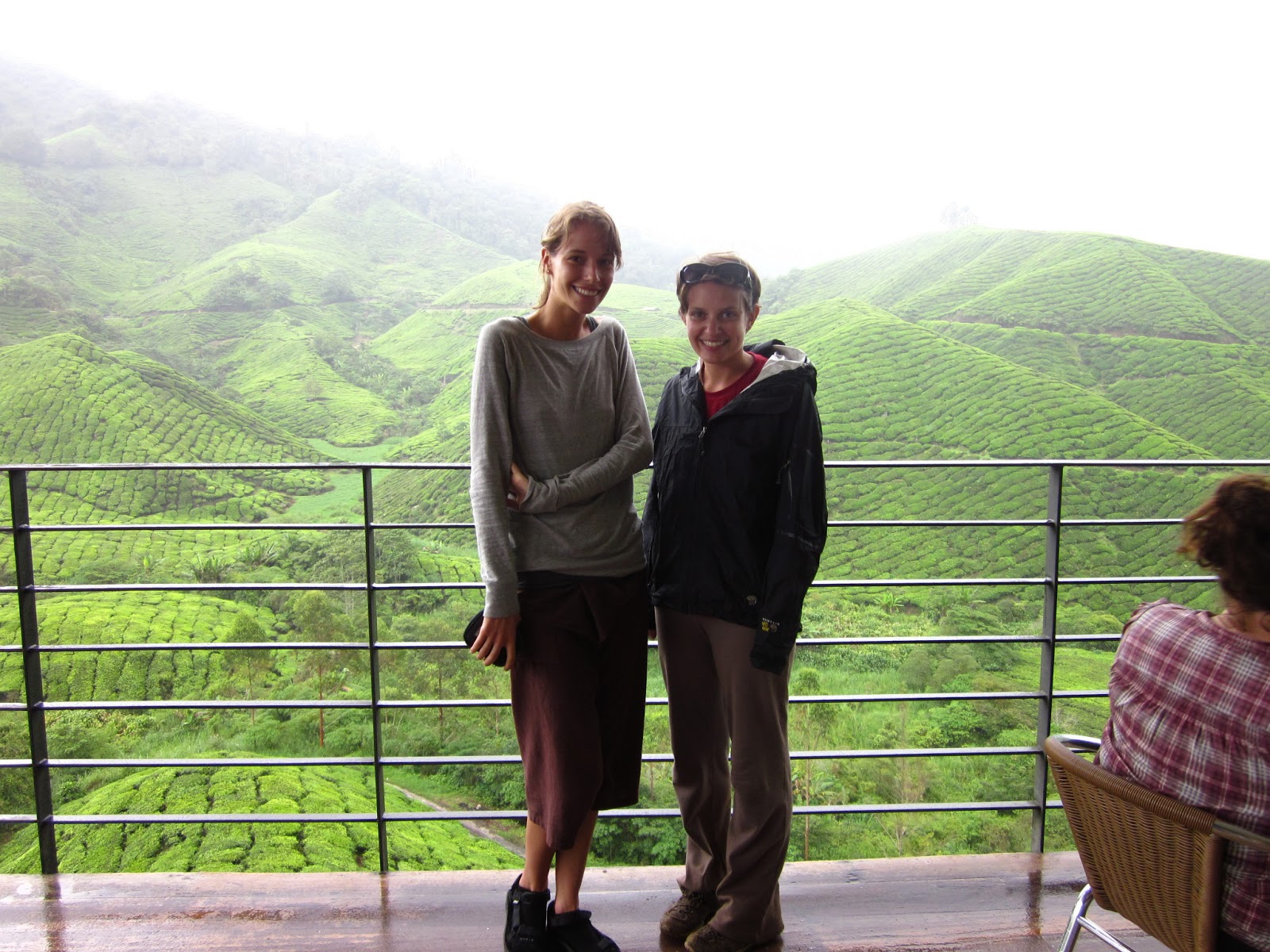
When we finished the hike, Spencer was waiting for us, the Jeep pulled out of the mud but still muddy. We piled in, despite how dirty we were and how much we smelled, and dropped our guide back off at the village before continuing to the tea plantation. The scenery there was absolutely stunning. The sun was briefly out, but everything was misty and wet. We drove by rolling hills, covered with rows and rows of neatly trimmed tea bushes. The greens were brilliant—jade, emerald. We wound around the hills of tea until we reached the Boh tea factory, where we went on a very brief tour and saw the machines and workers breaking the leaves down, drying, and sorting. Then we had a light lunch—apple pie and vanilla tea—at the tea shop. Malone had gone on a different half-day tour, and her group was visiting the tea factory at the same time, so I got to sit on the misty porch with her, overlooking the green tea fields.
I bought some black tea soap (which I have yet to use!), some green tea (which was delicious), and a postcard before we left and headed for the strawberry farm. There wasn’t much of the farm to see—just a few rows of strawberries growing in a large greenhouse—but we got to sample strawberry jam and dried strawberries and I bought 5 ringit worth of fresh strawberries, which were delicious.
Our last stop was the Butterfly Garden, which also housed insects and reptiles. I held a leaf-bug, a lazy gecko, and a leaf frog and got a closer look at a rhinoceros beetle and some red palm weevils when Spencer took them out of their tanks. The orchid praying mantis was particularly beautiful. There were tanks and tanks of snakes, some with ten or more tangled together, making it impossible to tell which body belonged to which head! Other tanks held geckos, chameleons, and other reptiles. There were beautiful butterflies and flowers in the butterfly garden. Between the butterflies, flowers, Rafflesia, strawberries, and tea leaves, it was truly a colorful day!
We brought an older Orang Asli man with us on our next part of the trip as a guide. It was a good thing because after only about five minutes of driving up the muddy, rutted road, we got stuck. I’m not really sure why Spencer thought he would be able to make it up this road. He only got the vehicle more and more stuck. Finally, he gave up, and the Orang Asli man took us into the jungle while Spencer walked back to town to get a tow.
I never got the name of our guide, but he led us on a vigorous hike in search of the Rafflesia, the world’s largest flower at up to a meter wide. We walked along the muddy road, where large clusters of bamboo grew tall, curving to the sky. From the gaps in the vegetation we could see a forest-covered mountain peak shrouded in mist. It was humid and I was sweating before too long. I saw a few leeches on the ground but, luckily, none on my body. We hiked over a bamboo bridge, through trails, over fallen trees, across a sandy spit and a small creek, and took a small side trail to find a few dead Rafflesia, fungus-like, dark brown and decaying, and one that had not yet opened but sat like a red cabbage on the forest floor. We then continued to make the longer trek to the flower that was in bloom.
On the way back to the main trail, our guide stopped and cut into a piece of bamboo with his machete. “Water bamboo,” he told me, and I looked inside the long tube, which was filled with water. He told me to try it, so I tipped the long tube back. “Slowly, slowly!” he warned, but the water sped down the chute and landed all over my chin and chest anyway. We continued down the trail, where butterflies flew about the rainforest, umbrella-like tree ferns grew, and bamboo predominated. We reached a raging, muddy creek, where we took our shoes off and our guide led us across the rocks to the other side with a walking stick. Once we crossed the river, we soon left the main trail again and headed up a steep, slippery path, grabbing the trunks of small trees to keep from sliding back down to where we had started. Our guide chopped down branches in our way, and he soon revealed the giant Rafflesia before him.
The flower was perched on the hillside, rusty red and beautifully bright amongst the brown, leaf-strewn forest floor. Its petals, thick, uncurled and unfolded themselves along the ground. Its center was like a hollowed-out gourd, inside of which a spiky heart sat. Insects buzzed around the spiked center. Near the flower, two baby buds claimed their spaces on the ground, and several more dead Rafflesia decayed.
Once we were finished marveling at the flower, we headed back down the muddy slope, reached the trail, and continued back down to the road. I led the way, walking as the hot sun came out. The bottoms of my pants were wet with mud and water from the creek. Butterflies hovered over the path, and at one point, after hearing a rustling in the bush, a wild pig—smaller than I would have expected one to be—sprinted across the path. As I walked toward where the pig had been, I noticed its digging in the mud, where it had been looking for worms.
When we finished the hike, Spencer was waiting for us, the Jeep pulled out of the mud but still muddy. We piled in, despite how dirty we were and how much we smelled, and dropped our guide back off at the village before continuing to the tea plantation. The scenery there was absolutely stunning. The sun was briefly out, but everything was misty and wet. We drove by rolling hills, covered with rows and rows of neatly trimmed tea bushes. The greens were brilliant—jade, emerald. We wound around the hills of tea until we reached the Boh tea factory, where we went on a very brief tour and saw the machines and workers breaking the leaves down, drying, and sorting. Then we had a light lunch—apple pie and vanilla tea—at the tea shop. Malone had gone on a different half-day tour, and her group was visiting the tea factory at the same time, so I got to sit on the misty porch with her, overlooking the green tea fields.
I bought some black tea soap (which I have yet to use!), some green tea (which was delicious), and a postcard before we left and headed for the strawberry farm. There wasn’t much of the farm to see—just a few rows of strawberries growing in a large greenhouse—but we got to sample strawberry jam and dried strawberries and I bought 5 ringit worth of fresh strawberries, which were delicious.
Our last stop was the Butterfly Garden, which also housed insects and reptiles. I held a leaf-bug, a lazy gecko, and a leaf frog and got a closer look at a rhinoceros beetle and some red palm weevils when Spencer took them out of their tanks. The orchid praying mantis was particularly beautiful. There were tanks and tanks of snakes, some with ten or more tangled together, making it impossible to tell which body belonged to which head! Other tanks held geckos, chameleons, and other reptiles. There were beautiful butterflies and flowers in the butterfly garden. Between the butterflies, flowers, Rafflesia, strawberries, and tea leaves, it was truly a colorful day!
For dinner I had mushroom soup (it was actually Campbell’s soup, which
isn’t something I normally eat, but it was nice to have some Western
food for a change!) followed by a quiet evening. In the morning, we packed and
got on a bus to Kuala Lumpur. It was an unpleasant bus ride down the
windy mountain roads, but we got off in the capital city for lunch. Our
bus to our next stop left later in the evening, so as our bus departed,
we got to see the city skyline at sunset.
Monday, February 25, 2013
Crossing the Border
My last image of Thailand was from the window of a bus (the seat was hard) as we drove south to the border—the sun setting in an orange sky to the west and a huge, full, bright moon rising over palm trees in a dusky sky to the east. This view was quite nearly destroyed by the odor of what must have been a feedlot or slaughterhouse a bit further down the road. It was dark when we got to the border and the area was, for the most part, vacant. We walked across the border after getting thoroughly checked and scanned for drugs—our luggage was even X-rayed. We entered Malaysia with our lives intact (there is a mandatory death penalty for transporting drugs) and not a bus or taxi in sight.
So we had a scrumptious dinner at the 7-11—Cup O’Noodles and chips, yum!—and spent the night in a dodgy room near an empty market right across the border. It was someone’s home, and we had our own closed-off room, but had to walk through the kids’ sleeping area to reach the bathroom, which, as it were, had no running water. I spent the night still itchy with my hives and psychologically itchy with bedbugs, but luckily, I was exhausted, and I slept. In the room next door was a British couple who had gotten off the bus with us. They told me that in the UK, doctors won’t prescribe Malarone, the anti-malarial I had been taking, for more than a month at a time. I wonder why! It certainly made me question the FDA's standards.
In the morning, we took a taxi to the bus station, a bus to Butterworth, a bus to Ipoh (where I ate watermelon and sweet corn at the bus station, having had only orange juice and cookies all day), and then finally a bus to the Cameron Highlands—Tanah Rata. After two full days of being transported, we finally were in a place we wanted to stay. Some hot tomato soup and garlic bread in town followed by a hot shower and a clean bed never felt so good.
We slept in the next morning. I had a peaceful, quiet day to myself in the mountain air (Malone was still feeling ill with her headache). The Cameron Highlands reminded me of Colorado. A tiny, one-street town was nestled in amongst the mountains, and the buildings just reminded me of a brick-building lined street in a small Colorado town. The day was rainy, and I think the cool, humid mountain air cured the remnants of my hives. I spent the day reading, writing on the sheltered porch of the hostel while the rain streamed down outside, exploring the town, and eating tasty Indian food. It was nice to have a peaceful day in a pretty place; the next day was packed and one of my favorite days in my memory!
So we had a scrumptious dinner at the 7-11—Cup O’Noodles and chips, yum!—and spent the night in a dodgy room near an empty market right across the border. It was someone’s home, and we had our own closed-off room, but had to walk through the kids’ sleeping area to reach the bathroom, which, as it were, had no running water. I spent the night still itchy with my hives and psychologically itchy with bedbugs, but luckily, I was exhausted, and I slept. In the room next door was a British couple who had gotten off the bus with us. They told me that in the UK, doctors won’t prescribe Malarone, the anti-malarial I had been taking, for more than a month at a time. I wonder why! It certainly made me question the FDA's standards.
In the morning, we took a taxi to the bus station, a bus to Butterworth, a bus to Ipoh (where I ate watermelon and sweet corn at the bus station, having had only orange juice and cookies all day), and then finally a bus to the Cameron Highlands—Tanah Rata. After two full days of being transported, we finally were in a place we wanted to stay. Some hot tomato soup and garlic bread in town followed by a hot shower and a clean bed never felt so good.
We slept in the next morning. I had a peaceful, quiet day to myself in the mountain air (Malone was still feeling ill with her headache). The Cameron Highlands reminded me of Colorado. A tiny, one-street town was nestled in amongst the mountains, and the buildings just reminded me of a brick-building lined street in a small Colorado town. The day was rainy, and I think the cool, humid mountain air cured the remnants of my hives. I spent the day reading, writing on the sheltered porch of the hostel while the rain streamed down outside, exploring the town, and eating tasty Indian food. It was nice to have a peaceful day in a pretty place; the next day was packed and one of my favorite days in my memory!
Friday, January 18, 2013
Final Days in Thailand; Heaven in Hat Railey
We took a three hour bus ride to Krabi and a taxi to the pier where we ate spicy pad Thai and waited for our longtail boat to set off for East Railey. As our boat arrived, we could see rock climbers on the limestone karsts. A tractor with a trailer attached to it pulled up near our boat, and we were transferred to the trailer and brought to the beach to avoid the boat getting stuck in the mud at low tide.
Hat Railey was more what I had in mind when I thought of Thai beaches, but even though this was a peninsula, you can only reach it by boat, and it was therefore expensive. We found a bungalow for 450 baht a night and then went exploring. Down the pathway from our bungalow was a beautiful cave called Diamond Cave, which was very spacious inside with dramatic stalagmites covering the walls and ceilings. There were small cave-like hollows in the limestone further along the path and macaques played in the trees along the way. When we reached the waterfront, the tide was starting to come in amidst the mangrove roots, and we had a fruit shake and dinner before heading back to our bungalow. There was a campfire near our bungalow and we spent time with some other travelers before heading to bed.
My hives were almost gone at this point, and I slept well and woke up late in the morning. After a banana shake and banana and chocolate pancake for breakfast, I set off on a trail behind our bungalow for Ton Sai Beach while Malone stayed behind to rest. The walk to the beach through the jungle was tough, with really steep hills, but it was green and beautiful. Out of the jungle, I reached the bungalows of Ton Sai, a community that seemed to cater more to young backpackers than did East Railey. The beach was more beautiful, too. It was heaven when I arrived. I put my pack down beneath a pandanus tree and went in the greenish-blue water, which was clear all the way to the limestone islands and blue sky. From the water, I could see the angled limestone cliffs lining the beach, with plams and mangrove trees in between. I read and wrote and swam as the tide went out, and eventually Malone joined me. As the water retreated toward the horizon, rocks appeared on the surface as the sandy bottom was exposed.
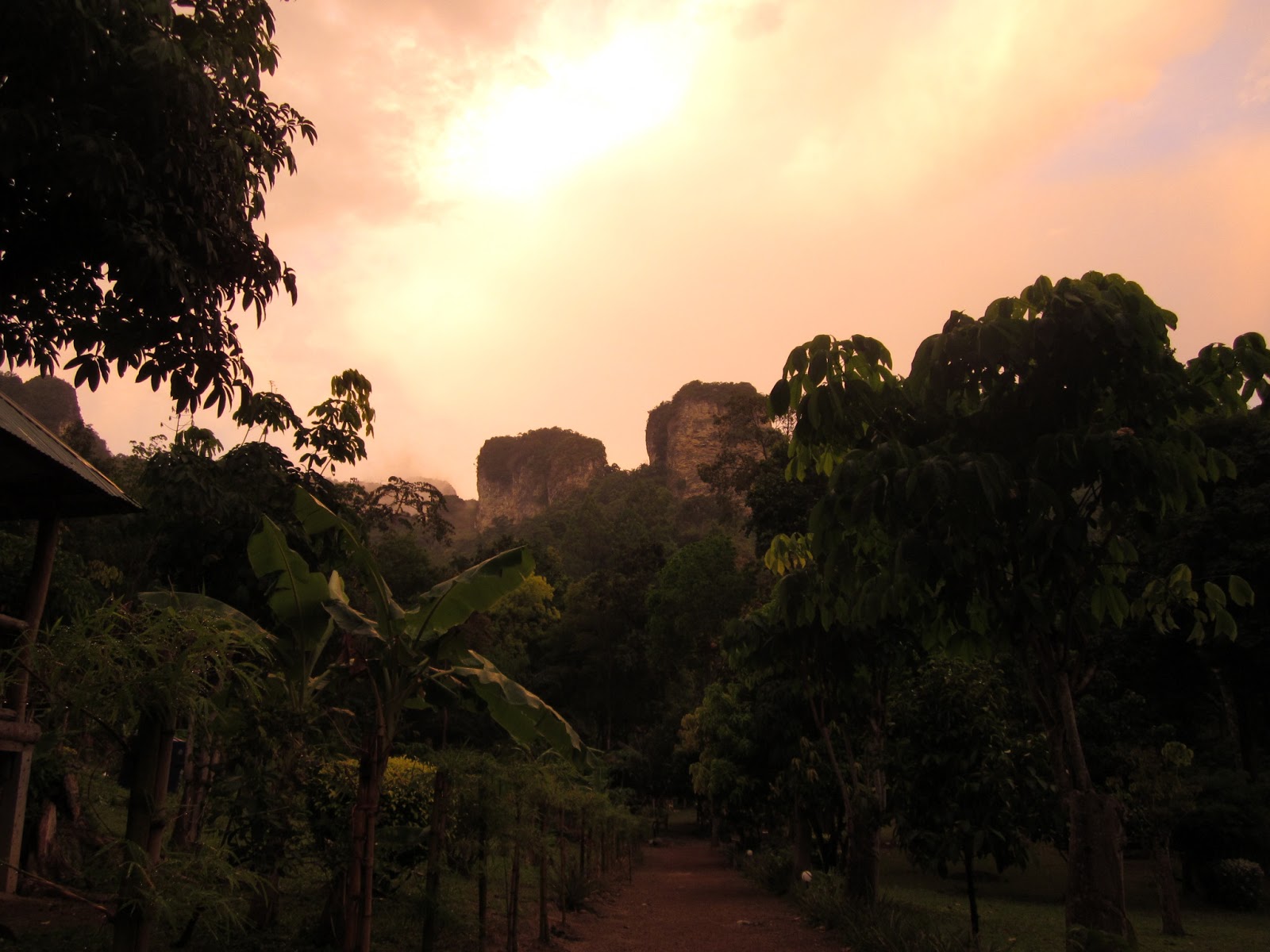
We sat at a beachfront restaurant and had fruit shakes before walking across the rocks at low tide to West Railey. This beach was the largest of the three, and there were waves, so we swam in the warm water. When it started to rain, we collected our things and walked back across a short path between West and East Railey for dinner and rest. We were met with a beautiful sunset and sky when we returned. These were our last moments in Thailand and a very peaceful way to end our stay in that country. The following day, we would cross the border into Malaysia.
Hat Railey was more what I had in mind when I thought of Thai beaches, but even though this was a peninsula, you can only reach it by boat, and it was therefore expensive. We found a bungalow for 450 baht a night and then went exploring. Down the pathway from our bungalow was a beautiful cave called Diamond Cave, which was very spacious inside with dramatic stalagmites covering the walls and ceilings. There were small cave-like hollows in the limestone further along the path and macaques played in the trees along the way. When we reached the waterfront, the tide was starting to come in amidst the mangrove roots, and we had a fruit shake and dinner before heading back to our bungalow. There was a campfire near our bungalow and we spent time with some other travelers before heading to bed.
My hives were almost gone at this point, and I slept well and woke up late in the morning. After a banana shake and banana and chocolate pancake for breakfast, I set off on a trail behind our bungalow for Ton Sai Beach while Malone stayed behind to rest. The walk to the beach through the jungle was tough, with really steep hills, but it was green and beautiful. Out of the jungle, I reached the bungalows of Ton Sai, a community that seemed to cater more to young backpackers than did East Railey. The beach was more beautiful, too. It was heaven when I arrived. I put my pack down beneath a pandanus tree and went in the greenish-blue water, which was clear all the way to the limestone islands and blue sky. From the water, I could see the angled limestone cliffs lining the beach, with plams and mangrove trees in between. I read and wrote and swam as the tide went out, and eventually Malone joined me. As the water retreated toward the horizon, rocks appeared on the surface as the sandy bottom was exposed.
We sat at a beachfront restaurant and had fruit shakes before walking across the rocks at low tide to West Railey. This beach was the largest of the three, and there were waves, so we swam in the warm water. When it started to rain, we collected our things and walked back across a short path between West and East Railey for dinner and rest. We were met with a beautiful sunset and sky when we returned. These were our last moments in Thailand and a very peaceful way to end our stay in that country. The following day, we would cross the border into Malaysia.
Subscribe to:
Posts (Atom)